
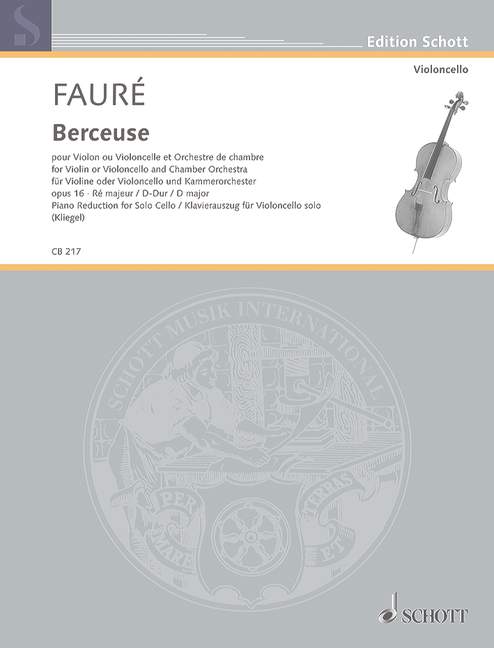


Berceuse D major op. 16 佛瑞 摇篮曲大调 大提琴加钢琴 朔特版
1877年5月22日,卡米耶-圣桑(Camille Saint-Saëns)在《巴黎音乐杂志》(Paris Journal de Musique)上如此称赞年轻同事的首部作品--加布里埃尔-福雷(Gabriel Fauré,1845-1924 年)的《第一小提琴奏鸣曲》。他接着说:"在它的上空和周围盘旋着一种魅力,这种魅力说服广大普通听众接受最激烈的新奇事物,认为它们是完全自然的。在 19 世纪末和 20 世纪初,室内乐和小型音乐仍然是这位重要的法国作曲家特别感兴趣的领域。福雷特别喜欢弦乐器,尤其是大提琴,他不仅为大提琴创作了两首美妙的奏鸣曲,还创作了一些小型独奏曲。Berceuse 作品 16 于 1878/79 年为小提琴而作;现在的编曲让中提琴演奏者也能尽情享受这首迷人而悠扬的摇篮曲"
作曲家: Fauré, Gabriel
编者: Kliegel, Maria
乐器: cello and piano
出版社: Schott Music
原文简介:
New forms, well-chosen modulations, strange timbres, the use of wholly unexpected rhythms', this is how Camille Saint-Saëns praised the first work of a young colleague, the First Violin Sonata by Gabriel Fauré (1845-1924), in the Paris Journal de Musique on 22 May 1877. He continued: 'Over it and around it hovers a charm which persuades the mass of ordinary listeners to accept the most violent novelties as being entirely natural.' Chamber music and the small forms continued to be the special fields of interest of this important French composer at the end of the 19th century and at the beginning of the 20th century. Fauré had a special liking for string instruments, particularly of the violoncello for which he wrote not only two wonderful sonatas but also some small solo works. Berceuse Op. 16 was written for violin in 1878/79; the present arrangement now allows even violoncellists to indulge in this beguiling and melodious lullaby.