
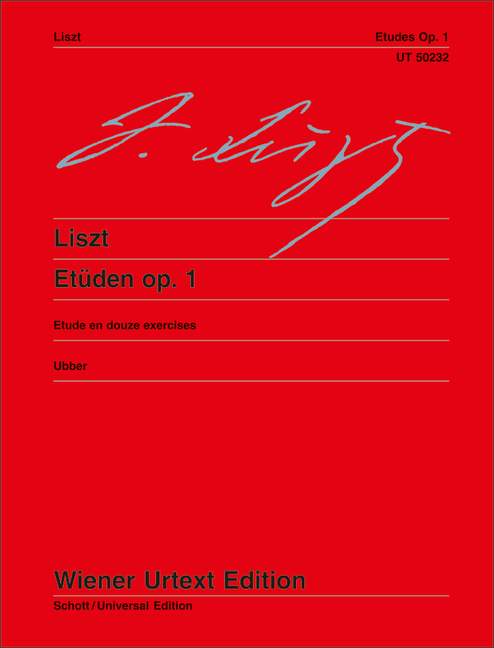
12 Studies op. 1 Etude en douze exercices
Original price
$950TWD
-
Original price
$950TWD
Original price
$950TWD
$950TWD
-
$950TWD
Current price
$950TWD
Composer: Liszt, Franz
Arranger: Ubber, Christian
Instrument: piano
Publisher: Wiener Urtext Edition
In 1826, 15-year-old Franz Liszt wrote his first cycle of studies which he actually wanted to be seen as a grand étude consisting of 12 different exercises, as an 'Etude en douze exercices'. Each of these exercises, however, is an independent study dealing with a certain technical problem. Although they became a model of Liszt's great études ('Grandes Etudes') later, these early works were still a far cry from the technical demands of their big siblings. They are all the more suited in advanced lessons as an excellent alternative to the more demanding studies of Czerny.
Arranger: Ubber, Christian
Instrument: piano
Publisher: Wiener Urtext Edition
Song List:
Etude Nr. 1 C-Dur / No. 1 C major / No 1 do majeur - Etude Nr. 2 a-Moll / No. 2 A minor / No 2 la mineur - Etude Nr. 3 F-Dur / No. 3 F major / No 3 fa majeur- Etude Nr. 4 d-Moll / No. 4 D minor / No 4 ré mineur - Etude Nr. 5 B-Dur / No. 5 B-flat major / No 5 si bémol majeur - Etude Nr. 6 g-Moll / No. 6 G minor / No 6 sol mineur - Etude Nr. 7 Es-Dur / No. 7 E-flat major / No 7 mi bémol majeur - Etude Nr. 8 c-Moll / No. 8 C minor / No 8 do mineur - Etude Nr. 9 As-Dur / No. 9 A-flat major / No 9 la bémol majeur - Etude Nr. 10 f-Moll / No. 10 F minor / No 10 fa mineur - Etude Nr. 11 Des-Dur / No. 11 D-flat major / No 11 ré bémol majeur - Etude Nr. 12 b-Moll / No. 12 B-flat minor / No 12 si bémol mineur
In 1826, 15-year-old Franz Liszt wrote his first cycle of studies which he actually wanted to be seen as a grand étude consisting of 12 different exercises, as an 'Etude en douze exercices'. Each of these exercises, however, is an independent study dealing with a certain technical problem. Although they became a model of Liszt's great études ('Grandes Etudes') later, these early works were still a far cry from the technical demands of their big siblings. They are all the more suited in advanced lessons as an excellent alternative to the more demanding studies of Czerny.